Local leak guide
What actually goes wrong with pipes in Manly
Pinholes, and why they are the coastal signature
Corrosion here does not split a pipe along its length. It eats through the wall at a point and produces a small hole, which weeps rather than bursts.
So the failure starts slowly and stays small for a long time, which means it hides considerably better than a burst does.
That changes the whole detection question, because you are looking for something that has been running quietly rather than something that just happened.
The tells worth acting on
A stain that dries and comes back. Rust-coloured marks around fittings. A patch of wall or ceiling that is never quite dry even in a dry week.
None of those is dramatic and all of them are easy to attribute to something else, particularly in a house near the sea where damp has other explanations.
Any of them recurring in the same place is worth a look rather than a wipe.
Salt gets inside the house
An internal run is not a protected run. Salt travels on the air through open windows and doors, and a house near the beach is open a great deal of the time.
So the pinhole pattern applies to internal pipework here too, not only to exposed external runs.
That is worth knowing, because it means an internal leak on a coastal property is more likely to be corrosion than it would be inland.
The meter is the honest test
Shut every tap and appliance and watch the meter for a quarter of an hour. Movement with nothing running means water is genuinely leaving on your side.
On a pinhole leak the loss can be small, so the fifteen minute version is worth doing rather than the two minute one.
Turn any irrigation off entirely rather than to a rest day, or it will run during the measurement.
The follow-up test, once a loss is confirmed
Shut the valve on the inlet to the hot water unit and take a second meter reading. It costs nothing and it removes half the property from consideration.
A dial that keeps moving is telling you the cold side. A dial that stops is telling you the unit or the hot line it feeds.
Have a look at the relief valve discharge point too. A steady dribble there reads as a leak and is an inexpensive fix rather than a search.
Why we do not open the stain
Water from a slow leak travels. It runs along the outside of a pipe, across a ceiling, down a stud, and surfaces wherever it finally can.
So the visible mark is where the water got out rather than where it got out of the pipe, and the two can be a long way apart.
Opening the stain is quick and satisfying and quite often reveals nothing but wet.
How we find it instead
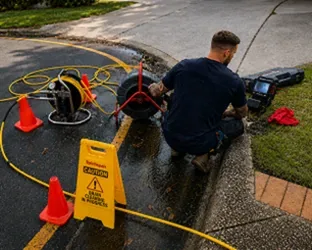
Acoustic listening for the sound a pressurised leak makes, thermal imaging for the heat signature of a hot water leak, and pressure isolation to narrow it section by section.
In that order, after the meter has confirmed there is something to find.
On a small pinhole the acoustic signature is quieter than a burst, which is why the sequence matters and why a systematic approach beats a search.
The insurance point that matters here specifically
Most policies cover sudden bursts and exclude gradual seepage. Coastal pinhole leaks are gradual by nature, which puts them on the wrong side of that distinction.
We are plumbers rather than assessors and we will not tell you what your policy covers. What we will do is document the fault, the date it was identified and what was done.
That documentation is worth having regardless of the outcome, and it cannot be produced afterwards.
One pinhole suggests the others
Corrosion is a condition of the pipework rather than an event at one point, so a first pinhole is information about the run rather than an isolated failure.
That does not mean replacing everything on the strength of one repair. It means knowing where you are.
Two in different places in a year is the installation reporting its condition, and it changes the question from what to fix to what to plan.
Find your stop tap before you need it
Not in the dark, in the rain, on the night it matters. Find the meter, find its tap, and check the tap actually turns on a dry afternoon.
Near the sea they seize more readily than they do inland, which makes checking it worthwhile rather than theoretical.
On a let property, put its location in the house information. Guests cannot be expected to find it.
Flexi hoses are still the fastest failure
For all the talk of corrosion, the thing most likely to flood a house here is a braided hose past its service life, and five years is the usual figure.
They fail all at once, at mains pressure, in a cupboard nobody opens, frequently while a property is empty between lets.
They are cheap and quick to replace, and on a let property they are the single most worthwhile preventative job there is.
Going away, or between guests
Close the isolating valves under the vanities, or the stop tap, whenever the property is empty for a stretch. It costs nothing and removes the risk for that period.
The failures that do serious damage are almost always the ones that ran unattended, and a holiday house has more unattended weeks than most.
It is the single most useful habit on this page for anybody letting a property.