Everyone near the coast knows salt air is hard on things. What people are rarely told is how uneven it is. Two identical hot water units, installed the same week on the same street, can be years apart in condition purely because of which wall they were fixed to.
That is worth knowing because it changes what you should do about yours. Age is the number everyone asks about. Position is the one that actually predicts what you will find when somebody looks.
Metal in a coastal environment corrodes several times faster than it does inland, because chloride breaks down the protective oxide layer that would otherwise slow it down. A hot water unit is usually the largest piece of exposed metal on the property and is usually on an external wall, so exposure decides its life. An exposed, seaward or west-facing wall with no shelter is a completely different situation from a sheltered southern one.
- Find out which wall your unit is actually on, and how sheltered it is
- Read the compliance plate for its real age
- Have the sacrificial anode checked earlier here than the usual advice suggests
- Look for staining and seeps rather than waiting for a burst
- Specify materials for the position when it is replaced, not just the model
On this page
1. Why salt is different from ordinary weathering
Most metals protect themselves. Copper, steel and galvanised iron all form a thin oxide layer on the surface, and that layer slows further corrosion down. It is why plumbing inland lasts as long as it does: the process is largely self-limiting.
Chloride ions break that layer down. Once the passive film is compromised the metal has no defence, and corrosion continues rather than slowing. That is the mechanism, and it is why coastal figures are not a slightly worse version of inland ones. Metal in a coastal environment corrodes something like five to ten times faster than it does inland.
It also explains the failure signature. Copper here tends to fail as pinholes: tiny perforations that seep slowly, rather than the dramatic burst people expect. That changes what you should be watching for entirely.
Salt arrives through open windows, vents and roof spaces, settles inside wall cavities and under floors, and holds moisture there. Plenty of the corrosion here happens well inside the building envelope.
2. Why the wall decides the outcome
A hot water unit is typically the largest single piece of exposed metal on a residential property, and in most houses it is fixed to an external wall. That makes it the item most directly exposed to the thing that does the damage.
- Seaward-facing, unsheltered. The worst case. Direct salt-laden air, wind-driven, with nothing intercepting it.
- West-facing. Salt plus afternoon heat and UV on the casing, which is hard on everything from the jacket to the fittings.
- Under an eave or in an alcove. Meaningfully better, because shelter reduces both the deposition and the wetting cycle.
- Southern or courtyard side. Generally the kindest position available, and worth considering when a unit is being replaced.
- Inside a cupboard or laundry. Different problem entirely, and a different set of questions about ventilation and overflow.
None of this is a reason to move a unit for its own sake. It is a reason to know which situation yours is in, because it changes how often it is worth looking at and what to expect when somebody does.
3. Sacrificial anodes matter more here, and sooner
A storage tank is protected by a sacrificial anode: a rod that corrodes deliberately so the steel of the tank does not. When the anode is consumed, the tank starts corroding instead, and the countdown on the unit begins.
The general advice about checking one is written for average conditions. Here the consumption is faster, so the check is worth doing earlier and it matters more when you do. Replacing an anode is a small job. Replacing a tank because nobody looked at the anode is not.
It is the single most cost-effective thing available on a unit you intend to keep, and it is almost never done, because nothing goes wrong until everything does.
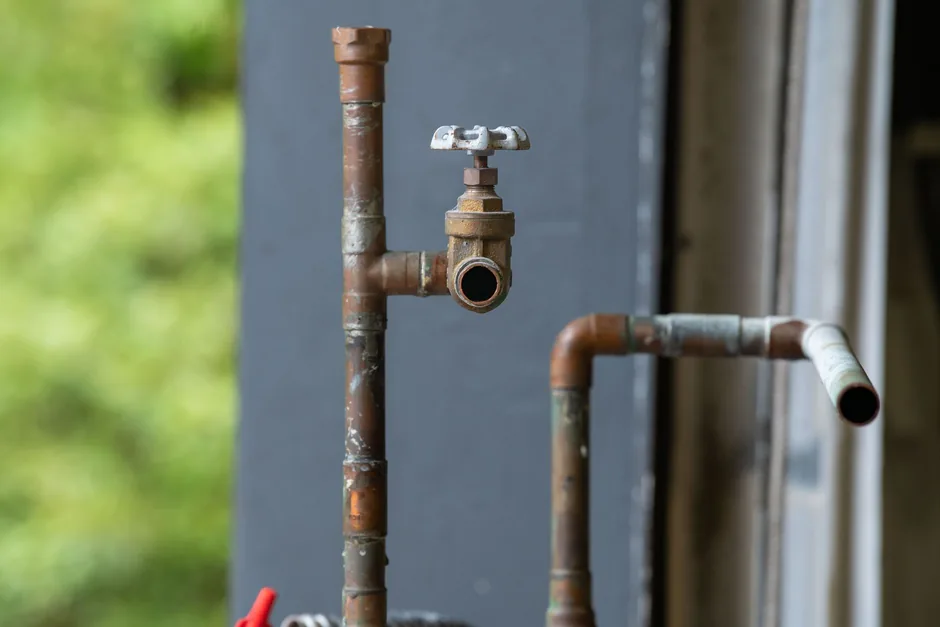
4. What to watch for, given it seeps rather than bursts
Because the characteristic failure here is a pinhole rather than a rupture, the signs are quiet ones. People wait for water on the floor and get a slowly rising bill instead.
- Staining or a green or white deposit on or below pipework and fittings.
- A damp patch on a wall or ceiling that never quite dries and never gets worse quickly.
- Water pressure that has drifted down over months rather than dropping suddenly.
- A water bill creeping up without any change in the household.
- Rust bleeding from the base of the hot water unit or from its brackets.
- A meter that moves with everything in the house turned off.
That last one is the definitive test and it takes ten minutes. Everything off, read the meter, wait an hour, read it again. Movement means water is leaving the system, which is the whole question a pinhole leak makes difficult to answer any other way.
Bill drifting up and nothing visible?
That is the classic coastal pattern. We can find a seep rather than wait for a burst.
5. When it is replaced, specify for the position
This is the practical advice that gets left out, and it is where the money is.
Replacement is usually discussed in terms of type and capacity: storage or continuous flow, gas or electric, how many litres. Those matter. What also matters here, and rarely gets raised, is what the fittings and brackets around the unit are made of, because they are exposed to the same environment and they are not all equally resistant.
Stainless and brass are not one thing. Grades differ in how they behave in a chloride environment, and specifying appropriately at installation costs a little once instead of a lot twice. It is a conversation worth having before the unit is ordered rather than after the brackets have rusted.
The same applies to position. If a replacement can reasonably go somewhere more sheltered, that is worth raising while it is still a plan.
6. What to ask when somebody quotes you
- What position is the unit in, and would a more sheltered one be practical?
- What grade are the fittings and brackets you are proposing?
- When should the anode be checked, given where this is installed?
- Has the existing pipework around the unit been looked at, or just the unit?
- Is there any staining or seeping on the connections?
- What is the actual age off the compliance plate?
A quote that answers all six is a quote from somebody who has worked on this coast. One that answers none of them is a quote written for a house anywhere.
- Metal corrodes several times faster in a coastal environment because chloride breaks the oxide layer.
- That means corrosion does not self-limit here the way it does inland.
- The hot water unit is usually the largest exposed metal on the property, so position decides its life.
- Sacrificial anodes are consumed faster here. Check earlier than the general advice suggests.
- The failure signature is pinholes and seeps: staining, drifting bills, falling pressure.
- At replacement, specify fittings and brackets for the position, not just the model and size.
Which wall it is on FAQs
How long should a hot water system last here?
It depends on the unit, the installation and above all the exposure, so we will not put a number on one we have not seen. What is fair to say is that an exposed, unsheltered position near the coast is a harder life than the general figures assume.
Should I move my unit to a more sheltered wall?
Not for its own sake, because relocating is real work. It is well worth raising when the unit is being replaced anyway, because at that point the cost difference is small and the benefit runs for the life of the new one.
What is a pinhole leak?
A tiny perforation in copper that seeps slowly rather than bursting. It is the characteristic coastal failure, and it is why the tells here are stains and creeping bills rather than water on the floor.
How do I check for a leak I cannot see?
The water meter. Turn everything off, including anything that refills, read it, then read it again an hour later. If the number has moved, water is going somewhere, and that is the answer a pinhole makes hard to get any other way.
Is a stainless fitting automatically fine near the sea?
No. Stainless is a family of materials rather than a single one, and grades behave differently in a chloride environment. That is exactly why it is worth specifying rather than assuming, and it is a cheap thing to get right at installation.
Does salt really get inside the house?
Yes. It arrives through open windows, vents and roof spaces, settles in wall cavities and under floors, and attracts moisture that keeps surfaces damp. That is why corrosion here is not confined to what you can see from the street.